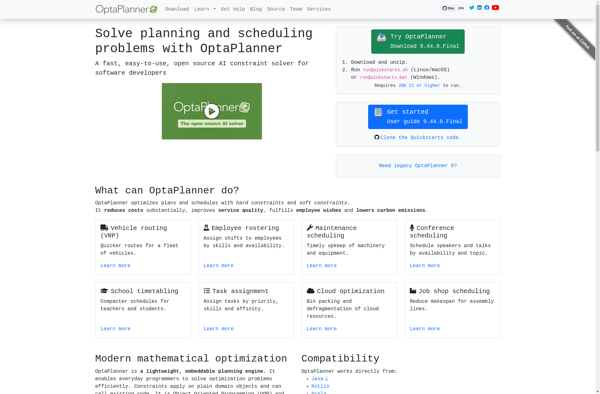
OptaPlanner is an open-source AI constraint solver that optimizes planning and scheduling problems. It implements optimization algorithms to find the best solution for resource planning, vehicle routing, task assignment, and more.
What is OptaPlanner?
OptaPlanner is an open source constraint solver for optimization problems. It uses artificial intelligence algorithms like tabu search, simulated annealing, and other heuristics to find the optimal or near-optimal solution for complex planning and scheduling problems.
Some key features and capabilities of OptaPlanner include:
Implements a variety of optimization algorithms like construction heuristics, local search, metaheuristics and more for fast and efficient optimization
Easy integration and configuration using XML and Java APIs
Cloud-native architecture that can leverage multi-core and multi-machine parallelization for large problem spaces
Solver optimization and benchmarking tools for monitoring and tuning solver performance
Supports a wide range of use cases like vehicle routing, workforce scheduling, bin packing, project scheduling, task assignment and more
OptaPlanner provides Java and REST APIs for integration into enterprise applications. It can be deployed on-premise or in the cloud. The constraint solver is highly customizable and extensible to address complex planning and resource optimization problems efficiently.
OptaPlanner Features
Features
Constraint satisfaction optimization
Integration with business rules engines
Support for a variety of programming languages
Cloud native and Kubernetes ready
Solver optimization and benchmarking
Pluggable persistence and incremental solving
Open source with enterprise support available
Pricing
Open Source
Enterprise Support Subscriptions
Pros
Powerful optimization algorithms
Highly customizable and extensible
Performs well on complex problems
Active open source community
Integrates well with various data sources and formats
Hyperon is an open-source platform designed to help developers build and maintain internal tools and applications. It takes a code-first approach, abstracting away infrastructure so developers can focus on writing code.Some key features and benefits of Hyperon include:Quick scaffolding - Get up and running in minutes with pre-built templates for...
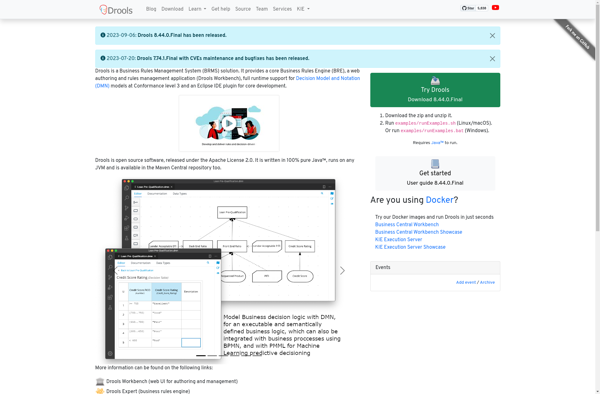
Drools is an open source business rules management system (BRMS) and rules engine for building expert systems and complex event processing. It provides a core business rules engine and tools for developing and managing business logic. Some key features and capabilities of Drools include:Declarative business rules language based on declarative...
Simple Rule Engine is an open-source Java library that provides a lightweight rule engine to execute business rules in applications. It allows developers to define conditions and actions in a readable domain-specific language, enabling non-programmers to manage application logic without needing to write code.Key features include:Lightweight API with no external...
IBM Operational Decision Manager (ODM) is a comprehensive decision management platform that enables organizations to capture, automate, govern, and analyze business decisions and their enforcement across applications and processes. It provides capabilities for:Authoring business rules and predictive analytic models using an easy-to-use interfaceTesting and validating decision logic across multiple test...
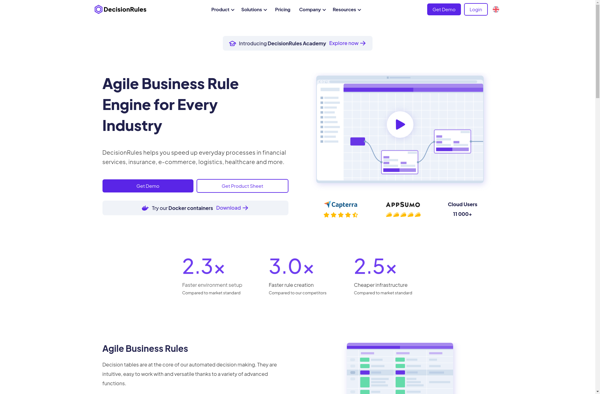
DecisionRules.io is a cloud-based no-code decision rules management platform designed to help businesses implement and scale decision logic across the organization. It allows both technical and non-technical teams to create, manage, and deploy complex decision rules and analytic models without the need for coding.Key features include:Visual rule builder with drag...
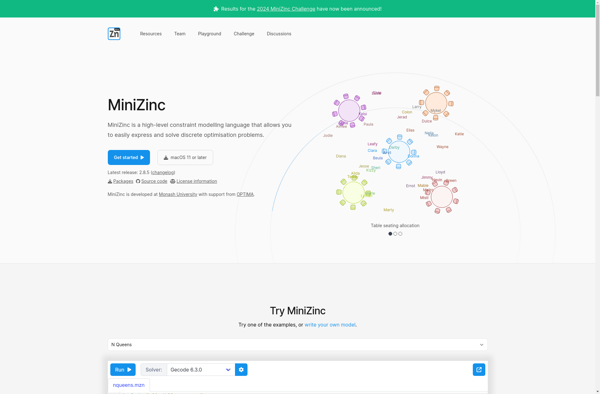
MiniZinc is an open-source constraint modeling language and solver developed at Monash University, NICTA, and Data61 in Australia. It provides a high-level, solver-independent language for modeling constraint satisfaction and optimization problems. Some key features of MiniZinc include:Expressive modeling language allowing the natural expression of complex, real-world constraintsSupport for integers, floats,...
Joget Workflow is an open source, low-code application platform for faster, simpler digital transformation. It allows organizations to empower business users, non-coders or coders to create enterprise applications and automate process workflows rapidly using a simple drag-and-drop interface.Some key capabilities and benefits of Joget Workflow:Visual app builder with hundreds of...
NxBRE is an open-source web browser that focuses on privacy and security. It is based on Chromium and blocks ads, trackers, crypto-miners, and other unwanted content by default. NxBRE does not collect or share any telemetry data about its users.Some of the key features of NxBRE include:Built-in ad blocker, anti-tracking...
NebriOS is a privacy-focused Linux distribution based on Debian and designed with security in mind. Some key features of NebriOS include:All network traffic is routed through the Tor network by default to prevent IP address leakage and protect users' privacy.Full disk encryption using LUKS is enabled to secure data in...
Ruote is an open-source workflow and business process management (BPM) engine written in the Ruby programming language. It allows users to define workflows made up of a series of steps, automate processes, connect disparate systems, and coordinate tasks across teams or applications.Some key features and benefits of Ruote include:Lightweight and...