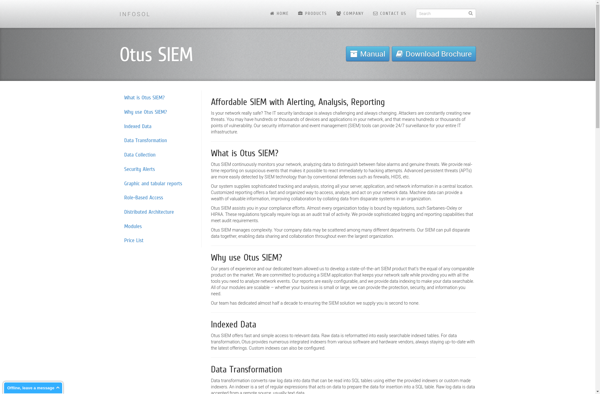
OTUS SIEM is a security information and event management system designed for enterprises. It collects and analyzes log data to detect threats, provide compliance support, and give visibility into an organization's IT infrastructure.
OTUS SIEM: Security Information and Event Management System
Security information and event management system designed for enterprises to detect threats, provide compliance support, and give visibility into an organization's IT infrastructure.
What is OTUS SIEM?
OTUS SIEM is a security information and event management platform purpose-built for enterprises that need to manage IT infrastructure at scale. It collects log and event data from across an organization's networks, endpoints, cloud services, and other systems.
Powerful analytics help OTUS SIEM detect advanced threats and zero-day attacks while providing intelligent incident prioritization and automated workflows. Pre-built compliance reporting also enables organizations to satisfy PCI, HIPAA, GDPR and other regulatory requirements.
Key capabilities and benefits of OTUS SIEM include:
Real-time collection and analysis of high volumes of machine data
Advanced correlation rules to detect sophisticated threats
Incident investigation tools like customizable dashboards
Compliance reporting for major regulatory frameworks
Scalable architecture suitable for large, complex environments
Rapid deployment options to accelerate time-to-protection
With an intuitive interface and automation focused on high fidelity alerts, OTUS SIEM reduces mean time to detection and recovery for security teams. Its analytics-driven approach also provides visibility across extended IT environments leading to lower risk and stronger security postures.
OTUS SIEM Features
Features
Collects and analyzes log data from various sources
Detects security threats and anomalies
Provides compliance support and reporting
Offers visibility into IT infrastructure
Customizable dashboards and reporting
Integrates with other security tools
Scalable and supports large enterprises
Pricing
Subscription-Based
Pros
Comprehensive security monitoring and analysis
Helps with compliance and regulatory requirements
Provides a centralized view of the IT environment
Customizable to fit organization's needs
Scalable to handle large volumes of data
Cons
Can be complex to set up and configure
Requires dedicated resources for maintenance and management
Pricing may be high for smaller organizations
Integration with legacy systems can be challenging
Datadog is a SaaS-based monitoring and analytics platform for cloud applications. It provides complete visibility into dynamic infrastructures by aggregating metrics, events, and logs from servers, containers, databases, tools, and services. This allows Dev and Ops teams to quickly solve performance problems, prove the root cause of software bugs, spot...
Splunk is a software platform that enables users to search, analyze, and visualize the data gathered from the infrastructure, systems, and applications of an organization. It captures, indexes, and correlates real-time data in a searchable repository from which it can generate graphs, reports, alerts, dashboards, and visualizations.Some key features and...
Prometheus is an open source monitoring and alerting system optimized for containerized environments like Kubernetes. It provides real-time visibility into applications, infrastructure, and services running in an environment.Prometheus works by scraping and storing time series data from various systems and services. It collects metrics from targets using either a pull...
Grafana is a feature-rich, open source analytics and monitoring visualization suite. It integrates tightly with a variety of database technologies like Graphite, Prometheus, InfluxDB, Elasticsearch, and more to allow for easy exploration and visualization of time series data. Some key capabilities and benefits of Grafana include:Intuitive graphical UI makes it...
Logstash is an open source, server-side data processing pipeline that ingests data from a multitude of sources simultaneously, transforms it, and then sends it to your favorite "stash."It is typically used as part of the ELK stack (Elasticsearch, Logstash, Kibana) for logging use cases. Logstash ingest data from various input...
Graylog is an open source log management and analysis platform optimized for high volumes of machine-generated data. It collects, indexes, and analyzes log messages, events, and other time-series data from various systems and applications.Some key features and capabilities of Graylog include:Real-time processing and analysis of log data as it is...
Papertrail is a cloud-based log management and analysis platform designed for infrastructure monitoring, application troubleshooting, and compliance reporting. It aggregates log data in real-time from servers, clouds, containers, and applications into a centralized, searchable web archive.Key features of Papertrail include:Real-time log streaming - Logs are streamed to Papertrail in real-time...
Grafana Loki is an open source logging aggregation system designed specifically for cloud native infrastructure. It is optimized for saving, indexing, and querying logs through labels and streams rather than unstructured text.Some key features of Grafana Loki include:Horizontally scalable - built on top of Prometheus's remote write protocol.Log queries -...
SenseLogs is a user research and feedback platform designed to help product teams better understand user needs and pain points. The software provides an end-to-end solution for planning, conducting, and analyzing qualitative user research.Key features of SenseLogs include:Recruiting - Integrates with panel providers to recruit target users that match your...
Octopussy is an open source log management and monitoring solution optimized for simplicity. It provides log aggregation from multiple sources, automatic parsing and analysis of log data, as well as visualization through dashboards and reports.Some key capabilities and benefits of Octopussy include:Centralized logging - Collect logs from various systems, servers,...
NXLog is an open source solution for log management, security information and event management (SIEM), and network security monitoring. It provides capabilities for log collection, processing, storage, search, reporting, and analysis.Some key features and capabilities of NXLog include:Multi-platform support - works on Windows, Linux, macOS, and Unix systems.Real-time log collection...
Graphite is an open-source monitoring and graphing tool used to store, visualize, and monitor time-series data from servers, applications, or other systems. It is designed to be highly scalable and robust for handling high volume metric collection and visualization.Some key features and components of Graphite include:Carbon - a high-performance service...
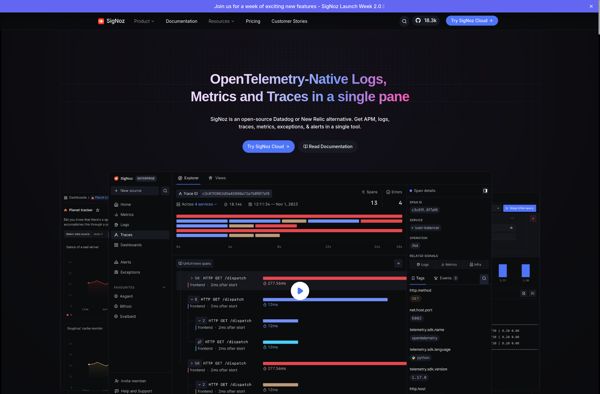
SigNoz is an open-source alternative to commercial Application Performance Monitoring (APM) tools like DataDog, New Relic, and Dynatrace. It is a cloud-native observability platform designed specifically for monitoring modern distributed systems.Some key capabilities and benefits of SigNoz include:Lightweight and optimized for microservices, serverless, and Kubernetes environmentsCollects metrics, traces, and logs...
Open Web Analytics (OWA) is an open source web analytics platform that you can use to track and analyze traffic on your websites. It provides a wealth of data to help you understand your visitors and make better decisions about your online marketing and content strategy.Some key features of OWA...
GFI EventsManager is a comprehensive log and event management solution designed to help organizations monitor IT infrastructure activity, achieve compliance objectives, and detect threats. Some key features include:Centralized logging - Collect and store logs from across your network including Windows, Linux, network devices and more in one secure location.Real-time monitoring...