PLoP Boot Manager is a small boot loader that allows booting different operating systems from CDs or USB drives on computers that do not support booting from such devices by default. It works by booting itself first, then loading the actual operating system boot loader.
PLoP Boot Manager: Boot Operating Systems from CDs or USB
A small boot loader for computers without default USB or CD support, allowing flexible OS booting from various media.
What is PLoP Boot Manager?
PLoP Boot Manager is a lightweight boot loader that enables booting operating systems from CDs, DVDs, or USB drives on legacy computers that lack support for booting from such devices. It works by booting itself first rather than relying on the computer's built-in BIOS boot loader.
When started, PLoP presents a simple menu allowing the user to select the external device to boot from. Behind the scenes, it initializes the hardware, sets up the disk subsystem, and finally jumps to the boot sector on the external media to load the OS boot loader. This allows older systems to boot Linux distributions, Windows installation media, and other operating systems even if the BIOS does not natively support external media booting.
Some key advantages of PLoP Boot Manager include: - Enables booting different OSes easily on older systems without altering the hard drive - Small storage footprint - fits on a floppy disk or tiny USB drive - Actively maintained and updated by its creator - Replaces needing a custom boot disk/floppy for systems without built-in USB booting - Allows quick troubleshooting or recovery tasks on machines with little native boot support
PLoP Boot Manager is released as a free, open source program requiring DOS and very little storage capacity. Its simplicity but vital role makes it a handy tool for retro computing or maintaining older systems.
PLoP Boot Manager Features
Features
Allows booting different operating systems from CDs or USB drives
Supports computers that do not have built-in support for booting from such devices
Boots itself first, then loads the actual operating system boot loader
Pricing
Free
Pros
Enables booting of operating systems on computers without native support
Small and lightweight, easy to use
Supports a variety of operating systems
Cons
May not be compatible with all hardware configurations
Limited customization options
Potential compatibility issues with some operating systems
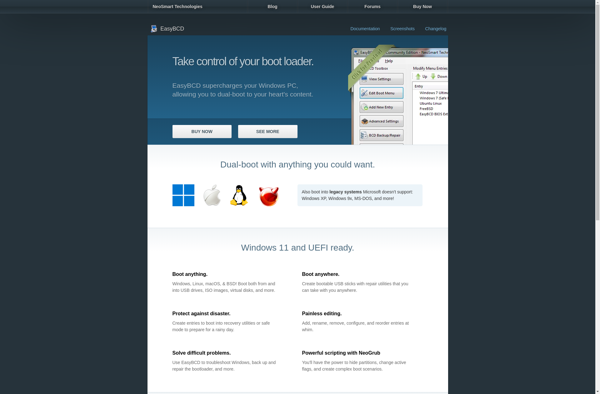
EasyBCD is a powerful bootloader configuration utility for Windows that gives you complete control over the boot process. It allows you to easily add, remove, edit, and configure operating systems and boot menus.Some of the key features of EasyBCD include:Add and configure multiple operating systems - You can add entries...
GRUB (GNU GRand Unified Bootloader) is an open source boot loader used to boot operating systems during start up. It is the default boot loader for most Linux distributions and is also available for BSD, Solaris, and other operating systems.When a computer first turns on, the BIOS initializes hardware components...
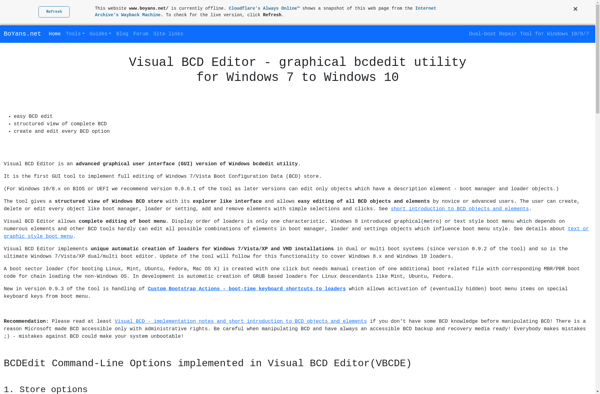
Visual BCD Editor is a free, open source software application designed for advanced editing and configuration of the Boot Configuration Data (BCD) store on Windows-based computers. The BCD store contains bootloader information and OS boot settings that control how Windows starts up.Visual BCD Editor provides an intuitive graphical user interface...
Grub2Win is a boot loader program that enables dual booting of Linux and Windows operating systems on a personal computer. It is based on the GRUB (GRand Unified Bootloader) boot loader commonly used in Linux.Grub2Win allows users to install multiple operating systems on the same computer and provides an interface...
EasyUEFI is a free, lightweight utility for Windows that allows you to manage your computer's UEFI/BIOS settings through an easy-to-use graphical user interface. It provides an alternative to entering your computer's BIOS setup utility directly, giving you the ability to view and configure BIOS settings in Windows without restarting your...
rEFInd is an open source boot manager for computers that use the Extensible Firmware Interface (EFI). It provides an alternative to the boot process used by default with EFI systems.Some of the key features of rEFInd include:Automatic detection of EFI-capable operating systems that are installed on the computerA clean graphical...
coreboot is an open source project that develops Linux-based firmware to replace proprietary BIOS/UEFI firmware on various computer hardware. The goal of coreboot is to initialize and test hardware components of a device and then pass control over to a bootloader that will load an operating system.Some key points about...
Libreboot is an open source boot firmware (a distribution of coreboot) that replaces proprietary BIOS/UEFI firmware found in most computers. It focuses on providing security, privacy, software freedom and fast boot times.Some key features and goals of Libreboot include:Using fully free and open source software for all firmware code, with...
GRUB4DOS and WINGRUB are open source bootloaders based on GNU GRUB, the standard bootloader for Linux systems. They allow booting into multiple operating systems from a USB drive or CD instead of having to install the bootloader onto a hard drive partition.Some key features include:Ability to boot Windows, Linux, and...
VMLite VBoot is a fast and lightweight virtual machine manager for Windows designed for simplicity and ease-of-use. It allows you to easily create, run, and manage virtual machines on your Windows desktop or laptop without slowdowns or bloat.Some key features of VMLite VBoot include:Intuitive and straightforward user interface to create,...
Super GRUB2 Disk is a bootable CD/DVD or USB drive that is designed to help repair and restore corrupted bootloaders and boot sectors on Linux and other operating systems. It contains multiple versions of the GRUB bootloader as well as a variety of diagnostics tools to identify and fix common...
Linux Loader, also known as LILO, is an open-source boot loader for Linux operating systems. It is used to load the Linux kernel into memory during the boot process so that the operating system can initialize and start running.As one of the first Linux bootloaders, LILO has a long history...