ShaderLab is a shader development tool used in Unity game development. It allows developers to create shaders using a shader language that gets compiled into GPU code. Shaders control the visuals and graphics in Unity games.
ShaderLab is a shader development tool used in Unity game development, allowing developers to create shaders using a shader language compiled into GPU code, controlling visuals and graphics in Unity games.
What is ShaderLab?
ShaderLab is a shader development tool integrated into Unity that allows developers to create shaders for their games without needing extensive knowledge of graphics programming. Shaders control the visuals and graphics rendered in a Unity scene.
With ShaderLab, developers can write shader code using the Unity ShaderLab language, which is then compiled into GPU code that runs efficiently on the target platform. The ShaderLab language is designed to be simple and easy to use, while still providing the flexibility to create complex shader effects.
Some key capabilities provided by ShaderLab in Unity include:
Surface shaders - For easily rendering polygon meshes with lighting and textures
Vertex & fragment shaders - For more advanced programmable shader effects
Property blocks - For exposing shader values to scripts
Built-in variables - For accessing rendered data within the shader
Compilers - For platform-specific shader optimization
By coding shaders with ShaderLab, Unity developers can quickly customize and enhance the visuals of their games without needing extensive graphics programming expertise. Common uses include creating textures, animations, lighting, reflections and special effects.
ShaderLab Features
Features
Node-based shader graph editor
Supports surface, vertex, fragment and compute shaders
Built-in nodes for common shader tasks
Allows mixing shader code with nodes
Real-time shader previews and debugging
Supports a wide range of render pipelines
Pricing
Free
Open Source
Pros
Visual shader creation makes shaders more accessible
Faster iteration than writing code from scratch
Large library of built-in nodes speeds up development
Easy to customize and extend with code
Integrated with Unity so no context switching
Cons
Less control than writing raw shader code
Can be harder to optimize shader performance
Limited to features built into nodes
Node-based shaders can be messy for complex effects
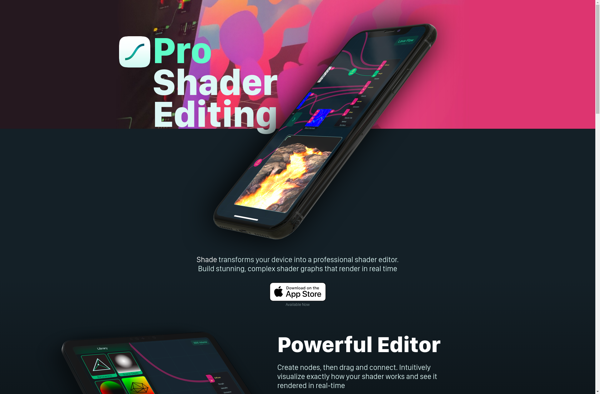
Shade is a professional shader editor and toolkit for creating shaders in Unity. It features a node-based visual shader graph workflow that allows you to build shaders by connecting nodes, without needing to write code. This makes the shader creation process more intuitive and visual.Some key features of Shade include:Node-based...
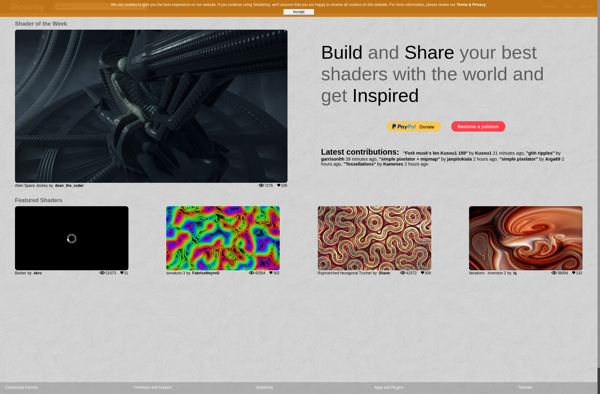
Shadertoy is an online community and tool for creating and sharing shaders. Users can write fragment shaders in GLSL and immediately see the results rendered in real-time. The site includes a basic code editor with syntax highlighting and automatic compilation and error checking.The gallery features thousands of shaders created by...
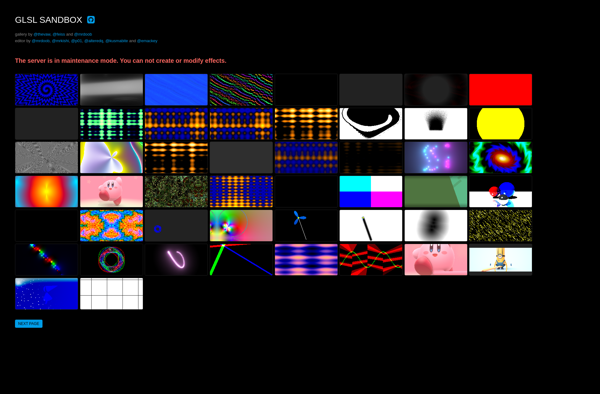
GLSL Sandbox is an online shader editor and gallery for GLSL shaders. It allows anyone to easily create shaders and share them with others. Some key features of GLSL Sandbox:In-browser shader editor with syntax highlighting, auto-completion, and error checkingReal-time shader compilation and rendering of resultsAdjust shader parameters with on-screen controlsShare...
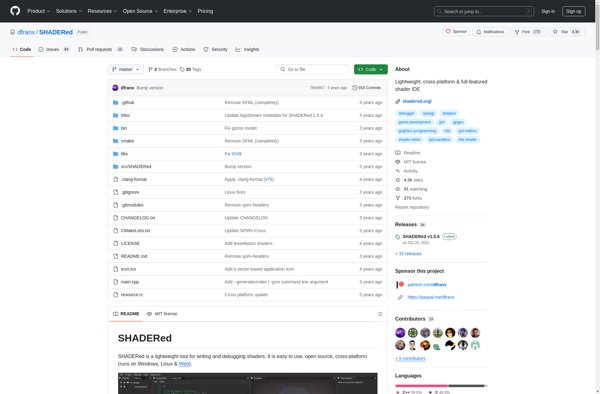
SHADERed is a lightweight, cross-platform & open-source tool for writing and debugging shaders. It aims to provide a unified interface for authoring all kinds of shaders, with a focus on usability and productivity.Key features include:Live editing of GLSL/HLSL shaders with syntax highlighting and autocompletionCompilation checking and error reportingBuilt-in shader viewer...
FX Composer is a powerful yet easy-to-use visual effects software for filmmakers, broadcasters, and video professionals. It offers advanced visual effects and motion graphics capabilities within a drag-and-drop interface that allows even beginners to achieve professional results.Some key features include:Hundreds of customizable effects templatesMotion tracking for blurring faces or objectsExtreme...
Shdr is an open-source shader manager and development toolset aimed at helping graphics programmers build, organize, and maintain shaders more efficiently. Developed by Graphics Programmer Jules Bloomenthal, Shdr seeks to improve upon existing shader workflows by providing a range of time-saving features and quality-of-life enhancements.At its core, Shdr serves as...
KodeLife is a lightweight yet full-featured integrated development environment and code editor designed specifically for web development. It comes packed with support and powerful features tailored for HTML, CSS, JavaScript, and other web technologies right out of the box.KodeLife provides syntax highlighting, autocompletion, and linting for popular web development languages...
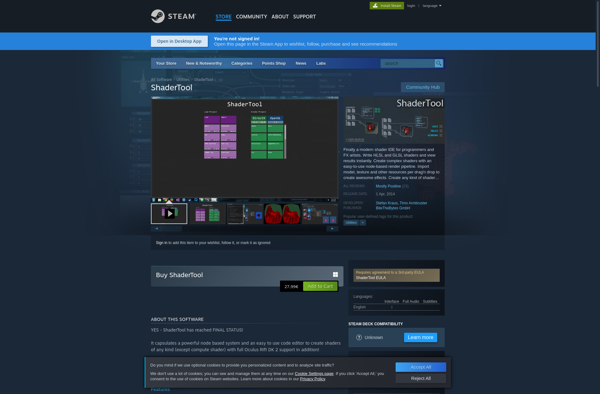
ShaderTool is a free and open-source add-on for the 3D creation suite Blender. It allows artists to create and edit shaders visually through a node-based interface, without needing to write code.With ShaderTool, you can quickly build shader graphs by connecting different nodes for textures, colors, math and logic operations, and...
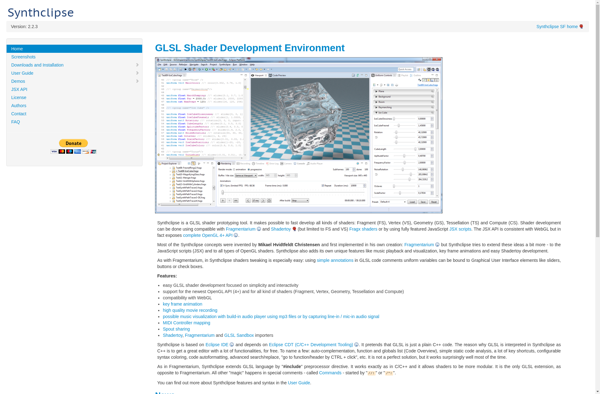
Synthclipse is an open-source and completely free modular synthesizer application and plugin available for Windows, Mac, and Linux operating systems. It provides users with a graphical modular interface to create virtual synthesizers using a wide range of modules including oscillators, filters, effects, sequencers, envelopes, LFOs, control modules, and more.The modules...
The Force is a cloud-based task and project management software designed for teams to organize workflows and collaborate effectively. It provides a variety of features to manage projects, tasks, teams, and documents in one place.Key features of The Force include:Kanban boards to visualize task workflows and project progressGantt charts for...
RenderMonkey is a physically-based renderer focused on ease of use and fast rendering speeds. It is a standalone application not tied to any specific 3D software. RenderMonkey uses raytracing and global illumination to produce photorealistic images with accurate lighting, shadows, reflections, and textures.Some key features of RenderMonkey include:Biased and unbiased...