Azure Cosmos DB
Azure Cosmos DB is a globally distributed, multi-model database service by Microsoft for mission-critical applications. It supports document, key-value, wide-column, and graph databases, and provides APIs for multiple platforms.

Azure Cosmos DB: Globally Distributed Multi-Model Database Service
A globally distributed, multi-model database service by Microsoft for mission-critical applications, supporting document, key-value, wide-column, and graph databases, with APIs for multiple platforms.
What is Azure Cosmos DB?
Azure Cosmos DB is a globally distributed, multi-model database service designed to enable you to elastically and independently scale throughput and storage across any number of Azure regions worldwide. It offers throughput, latency, availability, and consistency guarantees with comprehensive service level agreements (SLAs), something no other database service offers.
Key capabilities of Azure Cosmos DB include:
- Turnkey global distribution: Replicate data close to your users anywhere in the world.
- Guaranteed speed at any scale: Guaranteed low latency with single-digit millisecond response times at the 99th percentile.
- Five well-defined consistency models: Ensure the right level of data consistency chosen by you based on your application needs.
- Guaranteed high availability: Enjoy a 99.999 percent availability SLA across all single region accounts.
- No schema or index management: Store heterogeneous data and focus on your application instead of managing schemas or indexes.
- Automatic and instant scalability: Elastically scale storage and throughput worldwide, with no application downtime.
- Granular pricing control: Configure resources and pay only for what you need using a range of pricing options.
Azure Cosmos DB Features
Features
- Globally distributed database
- Multiple data models (document, key-value, wide-column, graph)
- Automatic indexing and querying
- Multi-master replication
- Tunable consistency levels
- Serverless or provisioned throughput
- SLAs for high availability
- Encryption at rest and in transit
Pricing
- Pay-As-You-Go
- Subscription-Based
Pros
High scalability and availability
Low latency worldwide access
Multiple APIs and SDKs
Automatic indexing and querying
Flexible data models
Serverless option reduces ops overhead
Cons
Can be more expensive than other databases
Steep learning curve for some features
Limited query support compared to SQL databases
Vendor lock-in
Reviews & Ratings
Login to ReviewThe Best Azure Cosmos DB Alternatives
View all Azure Cosmos DB alternatives with detailed comparison →
Top Ai Tools & Services and Databases and other similar apps like Azure Cosmos DB
Here are some alternatives to Azure Cosmos DB:
Suggest an alternative ❐
Redis
Redis is an open source, in-memory data structure store that can be used as a database, cache, and message broker. It provides high availability, performance, replication and supports data structures such as strings, hashes, lists, sets, sorted sets with range queries, bitmaps, hyperloglogs and geospatial indexes and streams.Some key features...

Amazon DynamoDB
Amazon DynamoDB is a fast, fully managed and serverless NoSQL database service provided by Amazon Web Services (AWS). It offers reliable performance at any scale, integrated security, and in-memory caching for internet-scale applications.Some key features of DynamoDB include:High performance at any scale - It can handle more than 10 trillion...


SAP HANA
SAP HANA is an in-memory, column-oriented, relational database management system developed and marketed by SAP SE. It provides real-time access to business data by storing the data in random access memory (RAM) instead of slower disk storage. This allows for much faster data processing and analytics.Some key features and capabilities...

IBM Lotus Approach
IBM Lotus Approach is a discontinued Windows-based database software that was developed and sold by IBM Lotus Software in the 1990s. It combined relational database capabilities with integrated office productivity tools such as word processing, spreadsheet, e-mail, calendar, and time management.Some key features of Lotus Approach include:Relational database for storing,...

Google Cloud Bigtable
Google Cloud Bigtable is a fully managed, scalable NoSQL database service designed for large analytical and operational workloads that require consistent high throughput and low latency. It is built on Google's proprietary Bigtable technology and features native integration with Google Cloud Platform tools.Key features of Cloud Bigtable include:Scales to billions...

Raven DB
RavenDB is an open source NoSQL document database optimized for storing, querying, and managing JSON documents at scale. Some key features of RavenDB include:Document-oriented storage allowing flexible schemas for your data modelsPowerful indexing and querying capabilities to slice and dice dataSupport for transactions across documents with ACID guaranteesBuilt-in replication, sharding,...

HyperDex
HyperDex is an open-source, scalable, searchable key-value store database designed for large-scale web applications and cloud services. It provides automatic sharding, fault tolerance, high availability, and ACID transactions to allow seamless scaling and zero downtime.Some key features of HyperDex include:Automatic sharding and rebalancing - data is automatically distributed across nodes...


Datomic
Datomic is a distributed database designed from the ground up to enable scalable, flexible and intelligent applications. Some key capabilities and features of Datomic include:Distributed architecture - Datomic can run across multiple servers/devices to scale up and handle large data volumes.Immutable data model - Datomic treats all data as immutable...

Hazelcast
Hazelcast is an open source in-memory data grid that provides a distributed architecture for scaling data and computation. It allows distribution of data and processing logic across multiple servers, enabling horizontal scalability, high performance, and resilience.Some key capabilities and uses cases of Hazelcast include:Distributed in-memory caching for low latency data...

Sybase Advantage Database Server
Sybase Advantage Database Server is a high-performance relational database management system designed for embedding in applications that require local data management. It offers a robust SQL database engine that delivers industrial-strength data management, securing business data with ACID compliance, referential integrity, and transaction processing.Key features include:ACID compliance for data integrityReferential...

Orient DB
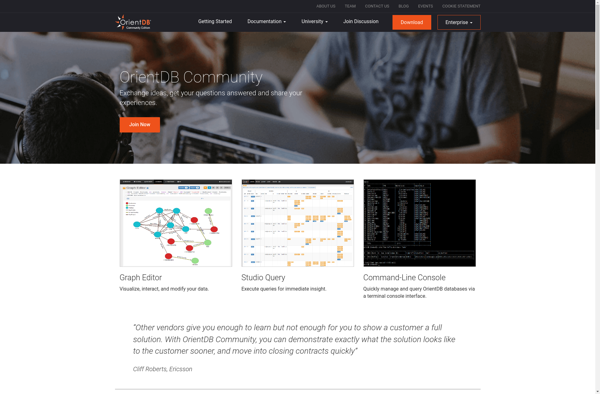
OrientDB is an open source multi-model NoSQL database management system written in Java. It supports graph, document, key/value, and object data models, allowing storage of relationships between data within the database.OrientDB uses a schema-less document graph data model that stores data in documents similar to MongoDB, but also allows you...

ArangoDB
ArangoDB is a native multi-model database system that supports multiple data models in one core engine and database system. The supported data models include graphs, documents (JSON documents), and key-value pairs. Using a single database system for multiple data models eliminates expensive data integration between systems and enables new graph...


Bluzelle Decentralized DB
Bluzelle is a decentralized, scalable database service optimized for managing blockchain data. It aims to solve the issues around performance and scaling that many blockchain-based applications face by providing a fast, reliable, and secure database solution that utilizes a global network of nodes.The Bluzelle database works by sharding and replicating...

Matisse
Matisse is a feature-rich vector graphics software designed for Windows. It enables users to create beautiful vector artwork from scratch for a wide range of purposes including illustrations, animations, UI/UX designs, logos, icons, diagrams, posters, and more.The application has an easy-to-use interface allowing both novice and professional illustrators to quickly...


KeyDB
KeyDB is an open source, high performance fork of Redis that supports additional data structures like Sorted Sets and Streams. It is developed by the Equilbrium company and aims to be a faster, more modular alternative to Redis while maintaining compatibility with Redis clients and data types.Some of the key...

NuoDB
NuoDB is a distributed SQL database management system designed for deployment in the cloud. It provides support for standard SQL queries while also delivering scalability, high availability, and performance through a distributed architecture.Some key features and capabilities of NuoDB include:Distributed architecture across multiple servers for scalability and resilienceIn-memory caching layer...


TayzGrid
TayzGrid is an in-memory data grid software developed by TIBCO. It is designed to improve application performance, scalability, and availability for read-intensive workloads.TayzGrid works by caching frequently accessed data in memory across a pool of servers. This avoids repeated queries to the database which can cause bottlenecks. The data grid...

Oracle TimesTen
Oracle TimesTen is an in-memory, relational database management system that is designed to improve application performance and reduce system overhead for transaction-intensive applications. Unlike traditional disk-based relational databases, TimesTen holds databases fully in physical memory to avoid disk I/O delays during transactions.Key features of TimesTen include:Extreme performance - By eliminating...


Action PSQL
Action PSQL is a powerful SQL Editor with advanced capabilities and features aimed at software developers and data analysts working with PostgreSQL and other databases. The centerpiece of Action PSQL is the SQL Editor pane where you can write and debug SQL queries.The SQL Editor provides syntax highlighting for various...


Polyhedra RDBMS
Polyhedra is an open-source relational database management system developed by Polyhedra Database Limited. It is designed for high availability and scalability in cloud and distributed environments.Some key features of Polyhedra include:Multi-master replication - Allows multiple nodes to concurrently accept write operations while continuously replicating to other nodesAutomatic failover - If...


ScimoreDB
ScimoreDB is an open-source NoSQL document database that is specifically optimized for storing, organizing, and analyzing scientific data. It was originally developed at the Scripps Research Institute to meet the data management challenges faced in modern biological, biomedical, and chemistry research.Unlike traditional relational databases, ScimoreDB employs a flexible schema-less data...

DeepDB
DeepDB is a next-generation database management system that leverages artificial intelligence and deep learning to optimize database performance. It was created by a startup called DeepMatter to reimagine what a database can do.Some key features and benefits of DeepDB include:Automated query optimization using machine learning - DeepDB continuously analyzes queries...

Postgres-XC
Postgres-XC is an open-source, shared-nothing clustering extension for PostgreSQL. It allows PostgreSQL to scale out to handle write-intensive workloads across multiple nodes. Some key features:Horizontal scalability and load balancing - Add more nodes to scale out performance for handling heavy workloadsShared-nothing architecture - Nodes do not share resources, improving performance...


FleetDB
FleetDB is an open-source time series database designed specifically for capturing high-velocity streams of numeric data like metrics, sensor readings, and events. It provides low-latency reads and writes, making it well-suited for monitoring and observability data.Some key capabilities and benefits of FleetDB include:Optimized for time series workloads - Time series...

BigMemory
BigMemory is an in-memory data management system developed by Terracotta. It provides a fast, scalable in-memory cache and data store for applications to boost performance.Key features of BigMemory include:Distributed in-memory data storage across multiple serversScales up to terabytes of data in memoryLow latency data access and high throughputPersistence options todisk...

Clustrix
Clustrix is a scale-out, distributed SQL database optimized for high performance analytics, machine learning, and operational workloads. Designed from the ground up as a scale-out relational database, Clustrix delivers sub-second response times and sustained performance with unprecedented linear scalability and fault-tolerance on commodity infrastructure. Leveraging patented distributed MVCC architecture, Clustrix...

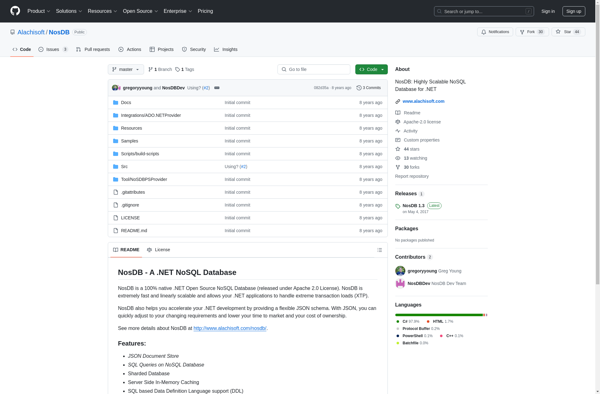
NosDB
NosDB is an open-source, schema-less, document-oriented database that is well-suited for modern applications that need flexibility and scalability. Here are some key features of NosDB:Document model - Data is stored in flexible JSON documents that can have varied structures and nesting, unlike rigid tables and rows in SQL databases.High performance...

Persevere
Persevere is an open-source NoSQL document-oriented database and web application platform. It is designed to provide a scalable data storage and synchronization layer for web and mobile applications requiring real-time data updates.Key features of Persevere include:Document-oriented database with JSON documentsReal-time data synchronization between clientsBuilt on Node.js for high performance and...


Frontbase
Frontbase is an open-source relational database management system (RDBMS) that is designed to be lightweight, fast, and easily embeddable into applications. Some key features of Frontbase include:Written in ANSI C for portability and performanceSmall footprint - can run on devices with as little as 32MB of RAMFull support for standard...


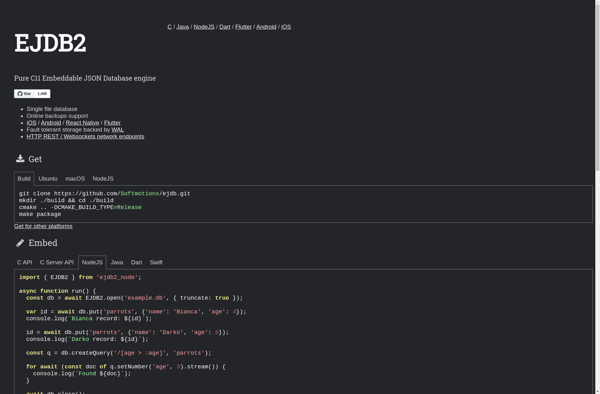
EJDB
EJDB is an embeddable JSON database engine that provides document-oriented database capabilities for applications that need to store and query JSON data locally. It is implemented as a C library that can be easily integrated into applications written in C/C++, and also provides bindings for many other programming languages.Some key...

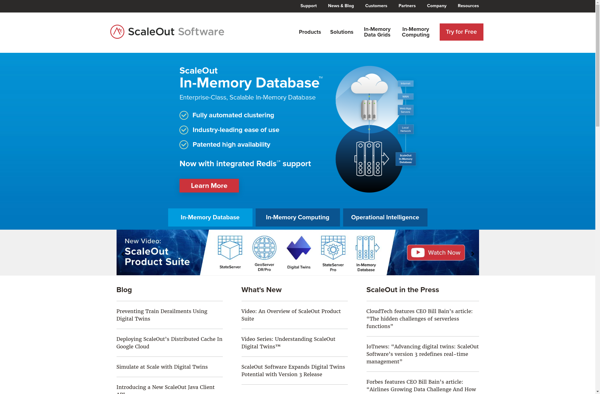
ScaleOut
ScaleOut Software is an enterprise-grade platform for scaling and accelerating analytics and machine learning applications. It enables organizations to get faster insights from big data by running distributed in-memory computing across clusters of commodity servers.Key capabilities and benefits of ScaleOut include:In-memory data grid for low-latency access to distributed datasetsMapReduce acceleration...