IBM Lotus Approach is a database software that combines relational database capabilities with integrated office productivity tools. It allows users to organize, analyze, and share data across the organization.
What is IBM Lotus Approach?
IBM Lotus Approach is a discontinued Windows-based database software that was developed and sold by IBM Lotus Software in the 1990s. It combined relational database capabilities with integrated office productivity tools such as word processing, spreadsheet, e-mail, calendar, and time management.
Some key features of Lotus Approach include:
Relational database for storing, organizing and managing data
Pre-defined templates and layouts for common business tasks like contact management, accounts, and inventory control
Drag-and-drop form design interface
Integrated reporting tools
Collaborative tools for sharing data across teams and departments
Scripting language for automating tasks
Can be used as a stand-alone product or client-server deployment
Originally launched in 1984 as Lotus Jazz for Macintosh, it was later renamed as Lotus Approach. It aimed to provide integrated data management and office productivity tools for business users. Over the years, several improved versions of Lotus Approach were released. However, with declining sales, it was eventually discontinued in 1997 as Microsoft Access became the leading database software.
IBM Lotus Approach Features
Features
Relational database
Integrated office suite
Data analysis tools
Data sharing capabilities
Customizable forms and reports
Pricing
One-time Purchase
Subscription-Based
Pros
Tight integration between database and office suite
MongoDB is an open-source, document database designed for ease of development and scaling. Some key advantages of MongoDB include:Document Model: MongoDB stores data in flexible, JSON-like documents rather than rows and columns used in traditional RDBMS. This allows for dynamic schemas and easy data manipulation.Scaling: MongoDB is highly scalable and...
MySQL Community Edition is a free and open source relational database management system (RDBMS). It uses Structured Query Language (SQL) and is one of the most popular database servers used for web applications. Some key features include:High performance database engine with support for high volume data and concurrent usersCross platform...
MariaDB is an open source relational database management system, created as a drop-in replacement for MySQL. It is developed by some of the original developers of MySQL and is intended to remain free and open source software under the GNU GPL.After Oracle acquired MySQL in 2010, the founders of MySQL...
CouchDB is an open-source NoSQL document-oriented database that focuses on ease of use and scalability. It uses a document-based data model that maps neatly to objects in web applications and fits better with object-oriented programming techniques compared to a relational database structure.Some key features and aspects of CouchDB include:JSON documents...
SQLite is an in-process library that implements a self-contained, serverless, zero-configuration, transactional SQL database engine. The code for SQLite is in the public domain and is thus free for use for any purpose, commercial or private.SQLite is the most widely deployed database in the world - it is used in...
PostgreSQL is a powerful, open source object-relational database system with over 30 years of active development. It has earned a strong reputation for its proven architecture, reliability, data integrity, robust feature set, extensibility, and the dedication of the open source community behind the software to consistently deliver performant and innovative...
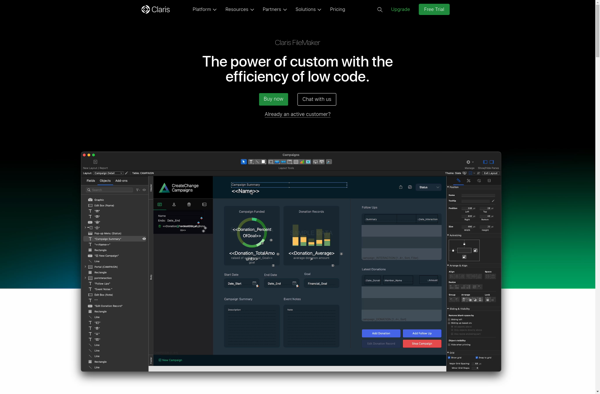
Claris FileMaker is a versatile database application platform that enables businesses and organizations to easily create custom database solutions tailored to their specific needs. Some key things to know about FileMaker:Works across Windows, Mac, iOS, Android, and web browsersFeatures an intuitive drag-and-drop interface for building database layouts and forms quickly...
Microsoft SQL Server is a relational database management system (RDBMS) developed by Microsoft. It is used for storing, retrieving, managing and analyzing data. SQL Server supports both online transaction processing (OLTP) and data warehousing workloads. Key features include:Support for structured, semi-structured and unstructured dataIn-Memory OLTP for faster transaction processingColumnstore indexes...
LibreOffice Base is a free and open source database management application included as part of the LibreOffice software suite. It provides tools for creating, accessing, and managing SQL databases without the need for any additional database software.Some of the key features of LibreOffice Base include:Graphical database design tools for creating...
RethinkDB is an open-source, distributed JSON document database designed for easy scalability and high availability. Some key features of RethinkDB include:JSON document storage with a flexible schemaIntuitive ReQL query languageChangefeeds for easy scale-out and replicationAutomatic sharding and failover handlingSimple administration with a clean CLI and web UIStrong consistency guaranteesPowerful indexing...
Azure Cosmos DB is a globally distributed, multi-model database service designed to enable you to elastically and independently scale throughput and storage across any number of Azure regions worldwide. It offers throughput, latency, availability, and consistency guarantees with comprehensive service level agreements (SLAs), something no other database service offers.Key capabilities...