Redis is an open-source, in-memory data structure store, used as a database, cache and message broker. It supports data structures such as strings, hashes, lists, sets, sorted sets with range queries, bitmaps, hyperloglogs, geospatial indexes and streams.
Open-source in-memory data structure store used as a database, cache and message broker with support for various data structures.
What is Redis?
Redis is an open source, in-memory data structure store that can be used as a database, cache, and message broker. It provides high availability, performance, replication and supports data structures such as strings, hashes, lists, sets, sorted sets with range queries, bitmaps, hyperloglogs and geospatial indexes and streams.
Some key features of Redis:
Supports data structures like strings, hashes, lists, sets, sorted sets, bitmaps, hyperloglogs, geospatial indexes and streams
Open source, in-memory and stores data in RAM for high performance and low latency
Master-slave asynchronous replication for high availability
Runs completely in memory but supports durability using snapshotting and append-only files
Multi-model database able to handle different kinds of workloads
Single-threaded avoids overhead from context switching, ideal for CPU-bound workloads
Used as database, cache, message broker, queuing system, gaming leaderboards, real-time analytics, geospatial, session store etc.
Redis powers many high-traffic sites and applications by providing a flexible data model, replication for scaling reads and high performance. Its versatility has made it a popular choice as a database, cache and message broker in modern applications.
Redis Features
Features
In-memory data structure store
Supports various data structures (strings, hashes, lists, sets, sorted sets, bitmaps, hyperloglogs, geospatial indexes, streams)
Used as a database, cache, and message broker
Provides high performance and low latency
Supports replication, clustering, and high availability
Supports a wide range of programming languages
Provides a rich set of commands and APIs
Supports data persistence (RDB and AOF)
Pricing
Open Source
Pros
High performance and low latency
Flexible and versatile data structures
Supports a wide range of use cases
Easy to set up and configure
Scalable and highly available
Open-source and free to use
Cons
In-memory nature can lead to data loss in case of system failures
Complexity in setting up and maintaining a highly available Redis cluster
Limited support for transactions and complex queries compared to traditional databases
Potential for high memory usage, especially for large datasets
Redis is incredibly fast and versatile for caching and real-time applications, and its support for various data structures is a major strength. However, the learning curve is steeper than I expected, especially when configuring it for persistence and high availability, …
Redis delivers blazing-fast performance for caching and real-time needs, which has been transformative for our application's speed. However, its in-memory nature means data persistence requires careful configuration, and we've had challenges with memory management during traffic spikes. The rich data …
Redis has been a game-changer for our application. We use it extensively as both a high-performance cache and for real-time features like leaderboards and session storage. The range of data structures, like sorted sets and streams, is incredibly powerful for …
Incredibly fast and versatile for our caching needs
We implemented Redis as a session cache and message broker for our web application, and the performance improvement was immediate. The variety of data structures like hashes and sorted sets gave us flexibility we didn't have with traditional databases, and …
Great for caching, but not a true database replacement
Redis is incredibly fast for caching and simple data structures, but we hit major issues using it as a primary database. The in-memory limitation means any server restart wipes all data, and persistence options felt like an afterthought with complex …
What Is MongoDB?MongoDB is a document-oriented NoSQL database that stores data in flexible, JSON-like documents instead of traditional rows and columns. It is one of the most popular databases for modern application development, particularly for applications that need flexible schemas and horizontal scaling.Key FeaturesMongoDB stores data as BSON (Binary JSON)...
Apache Cassandra is a free, open-source, distributed NoSQL database management system designed to handle large amounts of data across many commodity servers, providing high availability with no single point of failure.Key features of Cassandra include:Decentralized architecture with no single point of failureLinear scalability and proven fault-tolerance on commodity hardwareFlexible data...
CouchDB is an open-source NoSQL document-oriented database that focuses on ease of use and scalability. It uses a document-based data model that maps neatly to objects in web applications and fits better with object-oriented programming techniques compared to a relational database structure.Some key features and aspects of CouchDB include:JSON documents...
CockroachDB is an open-source, distributed SQL database that provides scalability, survivability, and data consistency across multiple datacenters. Some key features include:Distributed architecture that scales horizontallyAutomated replication and failover for high availabilitySupport for strongly consistent ACID transactionsGeographic distribution of data across multiple datacentersAutomatic rebalancing and repair after failuresSQL interface with support...
Amazon DynamoDB is a fast, fully managed and serverless NoSQL database service provided by Amazon Web Services (AWS). It offers reliable performance at any scale, integrated security, and in-memory caching for internet-scale applications.Some key features of DynamoDB include:High performance at any scale - It can handle more than 10 trillion...
Thiicket is an open-source lightweight spreadsheet software that can be used as an alternative to Microsoft Excel. It provides basic spreadsheet functionalities for data entry, formatting, calculations and analysis.Some of the key features of Thiicket include:Entering and formatting data in cells like text, numbers, dates etc.Support for basic formulas and...
Zenaton is an open-source workflow orchestration platform that allows developers to code any complex business process in code. It handles asynchronous tasks, priorities, scheduling, errors and more out-of-the-box allowing developers to focus on implementing the business logic rather than building custom workflow engines.Key features of Zenaton include:Model workflows in code...
Titan is an open-source, distributed graph database designed to handle large-scale graph data sets efficiently. It utilizes a NoSQL architecture and provides linear scalability, as well as real-time data access through a transactional database.Some key features of Titan Database include:Support for graph structures containing hundreds of billions of vertices and...
RethinkDB is an open-source, distributed JSON document database designed for easy scalability and high availability. Some key features of RethinkDB include:JSON document storage with a flexible schemaIntuitive ReQL query languageChangefeeds for easy scale-out and replicationAutomatic sharding and failover handlingSimple administration with a clean CLI and web UIStrong consistency guaranteesPowerful indexing...
HyperDex is an open-source, scalable, searchable key-value store database designed for large-scale web applications and cloud services. It provides automatic sharding, fault tolerance, high availability, and ACID transactions to allow seamless scaling and zero downtime.Some key features of HyperDex include:Automatic sharding and rebalancing - data is automatically distributed across nodes...
Apache Ignite is an open-source distributed database, caching, and processing platform designed for building real-time, scalable applications that need to process large data sets. It provides in-memory computing technologies such as a distributed key-value store, SQL and ACID-compliant transactions, data processing and analytics, and service grid.Key features of Ignite include:Distributed...
Apache HBase is an open-source, distributed, versioned, non-relational database modeled after Google's Bigtable. It is written in Java and runs on top of HDFS (Hadoop Distributed File System), providing Bigtable-like capabilities for Hadoop.HBase provides fast random access to large amounts of structured data. It scales linearly to handle huge tables...
Azure Cosmos DB is a globally distributed, multi-model database service designed to enable you to elastically and independently scale throughput and storage across any number of Azure regions worldwide. It offers throughput, latency, availability, and consistency guarantees with comprehensive service level agreements (SLAs), something no other database service offers.Key capabilities...
Couchbase is an open source, distributed multi-model NoSQL document-oriented database that is optimized for interactive applications. It provides sub-millisecond data operations, distributed across a scalable and flexible database cluster infrastructure designed for performance, scalability, and availability.Key capabilities and features include:Document-oriented storage of JSON documents as well as support for storing...
UnQLite is an embedded NoSQL database engine that provides a standard Key/Value store, as well as a Document Store with support for JSON documents. Some key features of UnQLite include:Written in pure C with no external dependencies, making it simple to integrate into applicationsFast in-memory and on-disk performance for reads...
Hazelcast is an open source in-memory data grid that provides a distributed architecture for scaling data and computation. It allows distribution of data and processing logic across multiple servers, enabling horizontal scalability, high performance, and resilience.Some key capabilities and uses cases of Hazelcast include:Distributed in-memory caching for low latency data...
ArangoDB is a native multi-model database system that supports multiple data models in one core engine and database system. The supported data models include graphs, documents (JSON documents), and key-value pairs. Using a single database system for multiple data models eliminates expensive data integration between systems and enables new graph...
Infinispan is an open source in-memory data grid and distributed cache written in Java. It offers extremely low latency and high availability for accessing data while also providing data reliability and resilience against failure.Infinispan works by distributing data across a cluster of servers running Infinispan nodes. The data is held...
Amazon ElastiCache is a fully managed in-memory caching service offered by Amazon Web Services (AWS). It provides fast, reliable caching for applications to improve response times and scalability.ElastiCache supports two popular open-source caching engines: Redis and Memcached. Both engines allow storing data in memory for low-latency data retrieval. Redis also...
Bluzelle is a decentralized, scalable database service optimized for managing blockchain data. It aims to solve the issues around performance and scaling that many blockchain-based applications face by providing a fast, reliable, and secure database solution that utilizes a global network of nodes.The Bluzelle database works by sharding and replicating...
VoltDB is an in-memory SQL database designed to enable fast data ingestion and low latency access for applications that need to process large volumes of data and transactions in real-time. Some key aspects of VoltDB:An in-memory database that keeps all data in RAM for faster access.A shared-nothing clustered architecture that...
Tarantool is an open-source NoSQL database and application server designed for real-time applications that require high performance and scalability. Some key features of Tarantool:In-memory NoSQL database for fast data access and real-time performance. Supports key-value, documents, timeseries and message queues.Lua application server for storing application logic and procedures inside the...
Cachelot is an open-source cache and session storage server written in Go. It is designed to be a fast, simple and scalable solution for caching data and sessions for web applications.Some key features of Cachelot include:In-memory storage for high performanceSimple JSON API over HTTPBuilt-in distributed caching and replicationDisk persistence for...
Memcached is an open source, high-performance distributed memory object caching system. It is designed to speed up dynamic web applications by caching data and objects in RAM to reduce the number of times an external data source (such as a database or API) needs to be read.Memcached is able to...
KeyDB is an open source, high performance fork of Redis that supports additional data structures like Sorted Sets and Streams. It is developed by the Equilbrium company and aims to be a faster, more modular alternative to Redis while maintaining compatibility with Redis clients and data types.Some of the key...
TayzGrid is an in-memory data grid software developed by TIBCO. It is designed to improve application performance, scalability, and availability for read-intensive workloads.TayzGrid works by caching frequently accessed data in memory across a pool of servers. This avoids repeated queries to the database which can cause bottlenecks. The data grid...
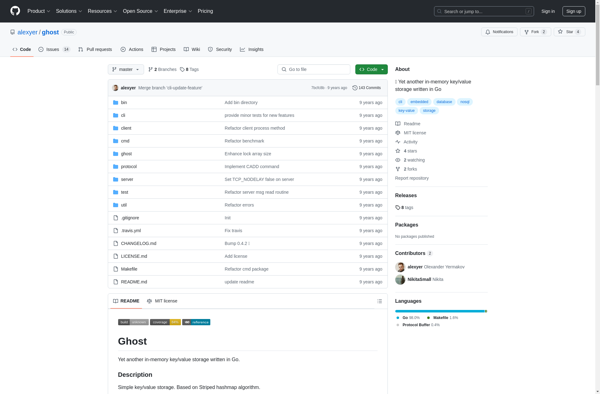
Ghost DB is an open-source time-series database optimized for managing large volumes of temporal data efficiently. It is purpose-built for handling time-stamped records like server metrics, application performance monitoring data, IoT sensor data, and industrial telemetry.Some key features and benefits of Ghost DB include:Horizontally scalable architecture that allows linear scaling...
ThisDB is an open-source, document-oriented database that is optimized for storing, querying, and indexing JSON data. Unlike traditional relational databases, ThisDB stores data in flexible, JSON-like documents rather than rows and columns.Some key features and benefits of ThisDB include:Document-oriented storage: Flexible schema design allows developers to modify applications without migrations...
Alternative PHP Cache (APC) is a free, open source opcode cache for PHP. It is designed to improve the performance of PHP applications by caching bytecode of PHP scripts in memory, reducing the amount of time needed to parse and execute scripts on each request.Some key features of APC include:Stores...
IBM Cloudant is a fully managed NoSQL document database service built specifically for web and mobile applications. It is offered as a cloud-based database-as-a-service (DBaaS) on the IBM Cloud platform.Key capabilities and features of IBM Cloudant include:Document-oriented storage for managing JSON dataIndexing and query through Cloudant QueryBuilt-in replication for data...
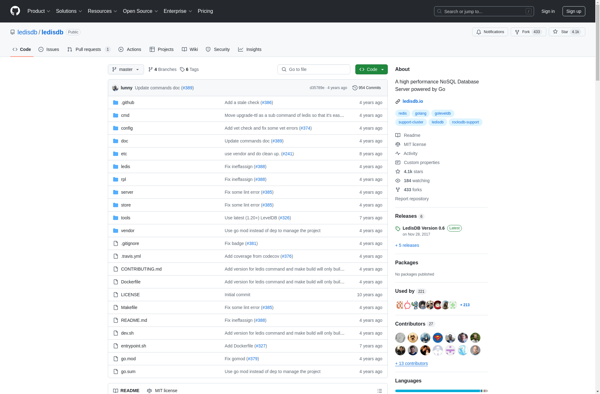
LedisDB is an open source NoSQL database developed by the Chinese company LedisTech. It provides high-performance, scalable data storage and retrieval for web-scale applications.LedisDB supports various data structures including strings, hashes, lists, sets and sorted sets, which is very similar to Redis. This allows developers to easily migrate applications from...
OrbitDB is a decentralized peer-to-peer database built on top of IPFS, the InterPlanetary File System. It provides an easy-to-use API for storing and managing data in decentralized networks and applications.Some key features of OrbitDB include:Peer-to-peer - Data is replicated directly between peers rather than relying on central serversDistributed and decentralized...
BigMemory is an in-memory data management system developed by Terracotta. It provides a fast, scalable in-memory cache and data store for applications to boost performance.Key features of BigMemory include:Distributed in-memory data storage across multiple serversScales up to terabytes of data in memoryLow latency data access and high throughputPersistence options todisk...
ScaleOut Software is an enterprise-grade platform for scaling and accelerating analytics and machine learning applications. It enables organizations to get faster insights from big data by running distributed in-memory computing across clusters of commodity servers.Key capabilities and benefits of ScaleOut include:In-memory data grid for low-latency access to distributed datasetsMapReduce acceleration...