bootcfg is a tool for managing machines that PXE boot using iPXE. It provides a user friendly interface for configuring boot options across large clusters of machines.
Bootcfg is a powerful tool for managing machines that use iPXE for PXE booting, providing an intuitive interface for configuring boot options across large clusters of machines.
What is Bootcfg?
bootcfg is an open source tool created by CoreOS for managing networks of machines that boot using the iPXE firmware. It is designed to work at scale across large clusters of machines by providing a simple yet powerful HTTP and gRPC API for managing iPXE boot configurations.
Some key features of bootcfg include:
A user friendly web UI for easily creating and customizing iPXE boot configs
Integration with matchbox for matching machines to profiles based on labels, UUIDs, or other attributes
gRPC API for programmatically managing boot configs
Template-based model for defining parameterized boot configs to simplify management
Integration with Container Linux, allowing it to serve authorized configs for provisioning clusters
Overall, bootcfg aims to greatly simplify managing network boot environments. Its simple abstractions make booting clusters of identically configured machines a breeze compared to more traditional PXE environments. The tool is commonly used with Container Linux from CoreOS to provision and maintain Kubernetes or other container cluster environments.
Bootcfg Features
Features
Manages PXE boot configurations for large clusters of machines
Provides a user interface to configure boot options
Supports iPXE for network booting
Allows setting default boot images and parameters per machine or group
Stores configurations in a database for easy management
Pricing
Open Source
Pros
Simplifies PXE boot management for large deployments
Intuitive UI compared to editing boot configs manually
Centralized control over boot process across multiple machines
Can configure different boot options for groups of machines
Free and open source software
Cons
Only works for systems that support iPXE
Additional software and infrastructure needed for PXE booting
May require learning curve for first-time users
Not as feature rich as some commercial solutions
Limited to managing boot process, not a full systems management tool
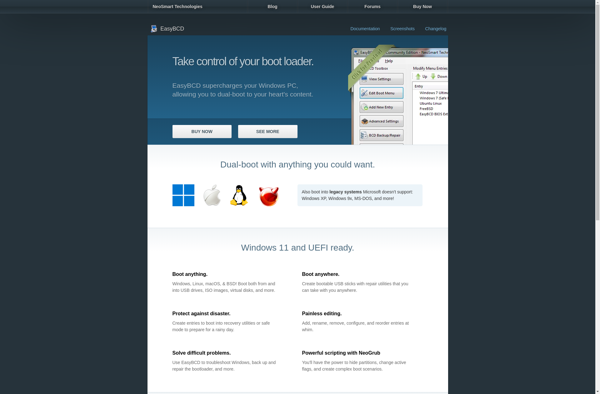
EasyBCD is a powerful bootloader configuration utility for Windows that gives you complete control over the boot process. It allows you to easily add, remove, edit, and configure operating systems and boot menus.Some of the key features of EasyBCD include:Add and configure multiple operating systems - You can add entries...
GRUB (GNU GRand Unified Bootloader) is an open source boot loader used to boot operating systems during start up. It is the default boot loader for most Linux distributions and is also available for BSD, Solaris, and other operating systems.When a computer first turns on, the BIOS initializes hardware components...
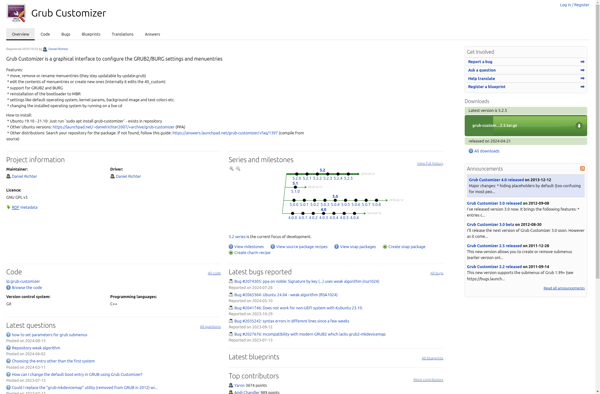
Grub Customizer is a graphical application for configuring settings related to the GRUB boot loader in Linux. It provides an intuitive interface that allows you to easily customize various GRUB options without having to manually edit configuration files.Some of the key features of Grub Customizer include:Editing the GRUB menu entries...
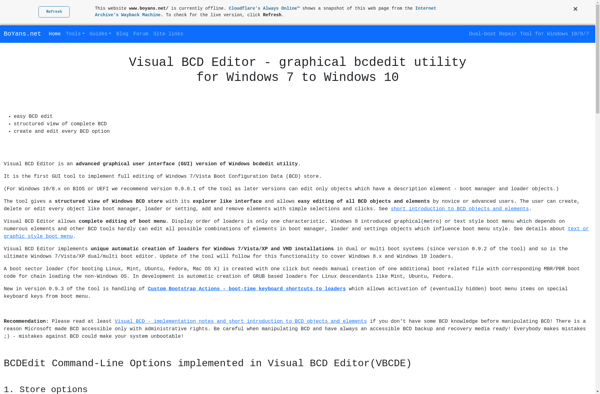
Visual BCD Editor is a free, open source software application designed for advanced editing and configuration of the Boot Configuration Data (BCD) store on Windows-based computers. The BCD store contains bootloader information and OS boot settings that control how Windows starts up.Visual BCD Editor provides an intuitive graphical user interface...
rEFIt (rEFInd Boot Manager) is an open source boot menu and system maintenance toolkit for computers that use the Extensible Firmware Interface (EFI) or Unified EFI (UEFI). It provides an alternative graphical boot menu to select operating systems or bootable tools.Some key features of rEFIt include:Graphical boot menu for EFI/UEFI...
Grub2Win is a boot loader program that enables dual booting of Linux and Windows operating systems on a personal computer. It is based on the GRUB (GRand Unified Bootloader) boot loader commonly used in Linux.Grub2Win allows users to install multiple operating systems on the same computer and provides an interface...
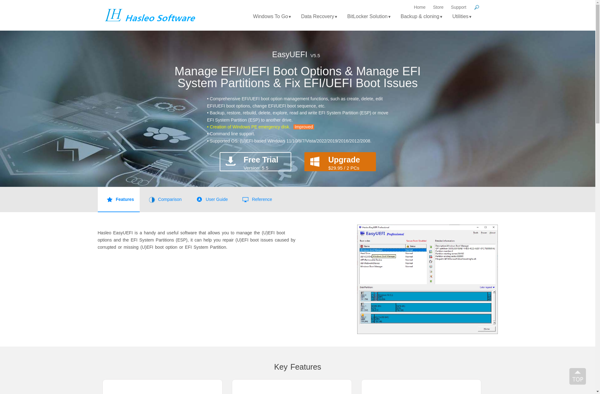
EasyUEFI is a free, lightweight utility for Windows that allows you to manage your computer's UEFI/BIOS settings through an easy-to-use graphical user interface. It provides an alternative to entering your computer's BIOS setup utility directly, giving you the ability to view and configure BIOS settings in Windows without restarting your...
Bootice is a lightweight yet powerful boot sector editing utility for Windows. It enables users to view, edit, restore, backup, and modify the master boot record (MBR) or boot sector of any hard drive or floppy disk.With an easy-to-use graphical user interface, Bootice allows you to perform various operations on...
GRUB4DOS and WINGRUB are open source bootloaders based on GNU GRUB, the standard bootloader for Linux systems. They allow booting into multiple operating systems from a USB drive or CD instead of having to install the bootloader onto a hard drive partition.Some key features include:Ability to boot Windows, Linux, and...
VMLite VBoot is a fast and lightweight virtual machine manager for Windows designed for simplicity and ease-of-use. It allows you to easily create, run, and manage virtual machines on your Windows desktop or laptop without slowdowns or bloat.Some key features of VMLite VBoot include:Intuitive and straightforward user interface to create,...
BootIt Bare Metal is a powerful boot manager and partitioning utility for hard drives. It allows you to easily install, configure and dual boot multiple operating systems on a single computer.Some key features of BootIt Bare Metal:Supports partitioning and imaging of hard drives, allowing you to resize, copy, split, format...
BootIt Next Generation (BING) is a powerful boot manager and hard drive partitioning utility for Windows and DOS. It provides the ability to easily install, configure, and boot multiple operating systems on a single computer.Some key features of BootIt BING include:Intuitive graphical user interface for managing partitions, volumes and boot...
Linux Loader, also known as LILO, is an open-source boot loader for Linux operating systems. It is used to load the Linux kernel into memory during the boot process so that the operating system can initialize and start running.As one of the first Linux bootloaders, LILO has a long history...