FSproxy is an open-source web proxy software that allows users to bypass filters and access blocked websites. It can be self-hosted on your own server for privacy.
What is FSproxy?
FSproxy is an open-source web proxy software designed to help users bypass filters and access blocked websites. It works by routing web traffic through an intermediate server, masking the user's original IP address. Some key features of FSproxy include:
Self-hostable - It can be installed on your own server for better privacy and anonymity. No logs or user data is collected.
Encrypted connections - Traffic is encrypted between the user and FSproxy server for security.
Anti-censorship - Specialized protocols allow it to avoid many censorship and blocking methods.
Active development - FSproxy is actively developed and maintained by a community of open source contributors.
By self-hosting FSproxy, you can create your own private proxy service to access blocked sites and services. It provides an extra layer of privacy and anonymity versus using a shared public proxy. The open source codebase allows security auditing as well. Overall, FSproxy is a great option for those seeking a transparent, self-hosted web proxy solution.
FSproxy Features
Features
Open source web proxy software
Allows bypassing filters and accessing blocked websites
Can be self-hosted on your own server for privacy
Works through a web interface that proxies sites through your server
Supports HTTP and HTTPS protocols
Pricing
Open Source
Pros
Free and open source
Provides privacy by allowing access to blocked sites
Can be self-hosted for full control
Actively developed and maintained
Cons
Requires server setup and maintenance
Does not hide your IP address without additional configuration
Requires some technical knowledge to setup and use
Ceph is an open source, software-defined storage platform designed for scalability, reliability, and cost-effectiveness. Here are some key things to know about Ceph:Provides block, object, and file storage in one unified system - Ceph supports traditional block device storage as well as object storage and scale-out file storage, allowing one...
DiskInternals Linux Reader is a free, easy-to-use utility that provides Windows users read-only access to partitions and disk images from Linux and macOS. It supports Ext2, Ext3, Ext4, ReiserFS, Linux SWAP, and HFS+ file systems.With DiskInternals Linux Reader, you can open local physical disks as well as disk images (ISO,...
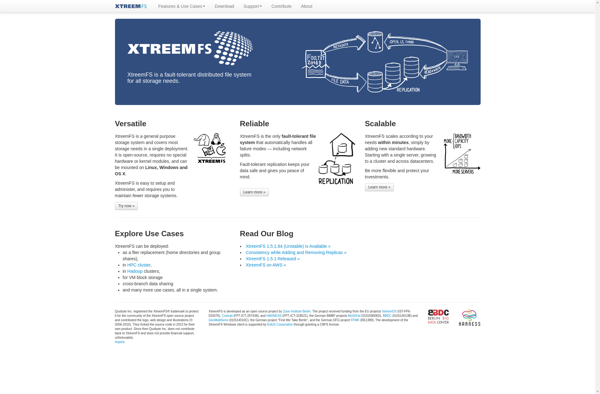
XtreemFS is an open-source distributed file system designed specifically for high availability, scalability and performance to store and access files across clusters of commodity servers. It provides interfaces for POSIX and HTTP access, allowing existing applications to use XtreemFS without any changes.Some key features of XtreemFS include:Scales to thousands of...
The Ext2 file system (second extended file system) was originally designed for Linux operating systems in 1993. It provides many advanced features compared to its predecessors like ext and ext1 while still emphasizing high performance, reliability and backwards compatibility.Some key features of Ext2 include:Supports file sizes up to 2 terabytes...
BeeGFS (short for 'Bee' Grid File System) is an open-source parallel file system designed for high-performance computing (HPC) environments. It runs on Linux clusters and helps improve I/O performance by distributing file data over multiple servers.Some key characteristics of BeeGFS:Designed for large-scale clusters and single Linux workstationsStripes data across multiple...
Ext2Read, also known as Ext2Explore, is an open-source ext2/ext3/ext4 file system driver and explorer for Microsoft Windows. It allows Windows users to access Linux file systems like ext2, ext3, and ext4 natively in Windows without having to dual boot or use virtualization.Some of the key features of Ext2Read include:Read access...
Lustre is an open-source, parallel file system designed for high-performance computing environments that require extremely fast I/O across large storage volumes. It delivers parallel access to files across clustered storage for supercomputing, machine learning, and other big data applications that need to process vast datasets efficiently.A key advantage of Lustre...