PetiteCloud is an open source platform-as-a-service for hosting web applications. It allows developers to deploy web apps and services without managing servers.
PetiteCloud: Open Source PaaS for Hosting Web Apps
Deploy web apps and services without server management, using PetiteCloud's open source platform-as-a-service
What is PetiteCloud?
PetiteCloud is an open source platform-as-a-service (PaaS) designed for hosting web applications and services. It provides developers with on-demand infrastructure to deploy, scale, and manage their apps without managing servers.
Key features of PetiteCloud include:
Supports popular languages like Node.js, Python, PHP, Ruby, Java
Built-in support for databases like MySQL, PostgreSQL, MongoDB
Auto-scaling of apps based on demand
Integrated monitoring tools for tracking app performance
RESTful API for automation and integrating with DevOps workflows
Open source under Apache 2.0 license with community-driven development
PetiteCloud aims to make cloud-based deployment easy for developers. Its automated infrastructure allows focusing on writing code rather than configuring servers. It's ideal for startups and companies wanting to deploy web apps without heavy investment in infrastructure.
With modular architecture and vibrant developer community, PetiteCloud offers a lightweight, customizable PaaS for modern app deployment and scaling needs.
PetiteCloud Features
Features
Open source platform-as-a-service
Hosting for web applications and services
Automated server management
Scalable and flexible deployment
Support for various programming languages
Integrated build and deployment pipelines
Monitoring and logging capabilities
Pricing
Open Source
Pros
Eliminates the need to manage servers
Flexible and scalable hosting solution
Supports a wide range of programming languages
Automated deployment and scaling
Open source model allows for community contributions
Cons
Limited customization options compared to self-hosted solutions
Potential vendor lock-in
Performance may be affected by multi-tenancy
Dependency on the platform provider's infrastructure and reliability
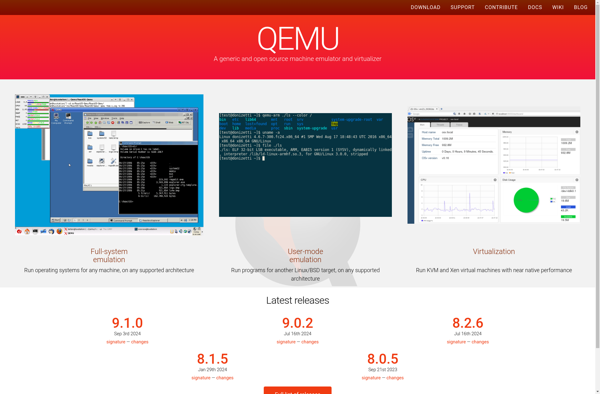
QEMU is a free and open source hypervisor and machine emulator. It emulates a complete computer system, including the processor, memory, storage, network interfaces and peripherals. This allows you to run software and operating systems written for one machine on a different machine.Some key features of QEMU include:Full system emulation...
What Is OpenStack?OpenStack is an open-source cloud computing platform for building and managing public and private clouds. It provides infrastructure-as-a-service (IaaS) capabilities similar to AWS, allowing organizations to run their own cloud infrastructure on commodity hardware.Key FeaturesOpenStack consists of modular components: Nova (compute), Swift (object storage), Cinder (block storage), Neutron...
Oracle VM VirtualBox, commonly referred to as VirtualBox, is a powerful and open-source virtualization platform developed by Oracle. It allows users to create and manage virtual machines (VMs) on a host machine, enabling the simultaneous execution of multiple operating systems on a single physical system. Key Features: Cross-Platform Support: VirtualBox...
VMware vSphere Hypervisor is a free bare-metal hypervisor that enables server virtualization, allowing multiple operating systems to run on the same physical server. It provides a robust, production-grade hypervisor layer that allows for greater hardware consolidation, improved availability and simplified management.Some key features of vSphere Hypervisor include:Workload optimization and compatibility...
Windows Sandbox is a virtualized desktop environment included in recent versions of the Windows 10 and Windows 11 operating systems. It allows users to run untrusted or unreliable software applications in an isolated environment without risking damage to the host device or operating system.Sandbox provides a lightweight virtual machine that...
Microsoft Hyper-V Server is a free, standalone product from Microsoft that provides a hypervisor-based virtualization platform for running virtual machines on x64 Windows servers. It has a small footprint and requires limited system resources while providing a simple and reliable virtualization solution.As a hypervisor, Hyper-V creates and runs virtual machines...
Multipass is an open source virtual machine manager developed by Canonical for Linux, Windows and macOS operating systems. It allows users to easily create, manage and run Ubuntu virtual machines.Some key features of Multipass include:Simple command line interface to launch, delete and manage Ubuntu VMsLightweight and fast VM launch timesSupport...
MicroCloud is an open-source private cloud computing platform built using proven open-source technologies. It aims to provide users with an easy way to deploy virtual machines and containers in their own private cloud infrastructure, without the cost and privacy concerns of public cloud providers.At its core, MicroCloud uses libvirt and...
VirtualBuddy is an advanced virtual assistant software powered by artificial intelligence and natural language processing. It is designed to help individuals and teams improve productivity and efficiency by automating administrative tasks and providing useful information on demand.Users can interact with VirtualBuddy completely hands-free using natural voice commands. It can take...