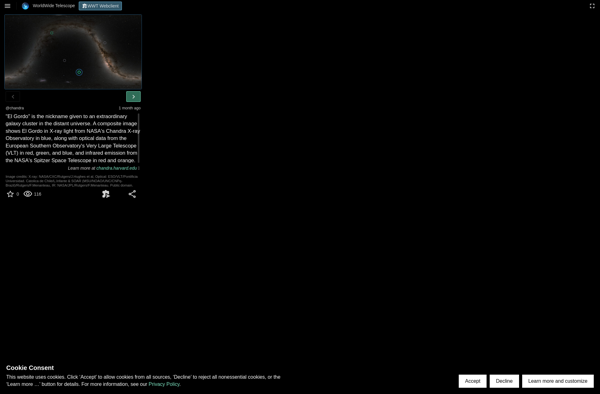
WorldWide Telescope is a free, open-source planetarium software program developed by Microsoft Research that allows users to explore and view the night sky in 3D. It provides a visualization of the universe using images from telescopes and spacecraft combined with terrain and oth
A free, open-source planetarium software program providing a 3D visualization of the universe with images from telescopes and spacecraft combined with terrain and other datasets.
What is WorldWide Telescope?
WorldWide Telescope (WWT) is a free, open-source planetarium software program originally developed by Microsoft Research. It allows users to explore and visualize the universe in 3D using real data and imagery from ground and space-based telescopes.
Some key features of WorldWide Telescope include:
Interactive 3D views of the night sky from any location on Earth or in space
Integration of images and data from major telescopes and astronomical surveys like Hubble, Chandra, SDSS, and more
Universe mode with 3D visualization of galaxies, nebulae, and other deep space objects
Planet mode to explore high resolution maps of bodies in our Solar System
Tours created by astronomers, educators, and others to guide learning and exploration
Customizable user interface with support for multiple languages
Availability as a Windows application, in web browsers via WebGL, and through planetarium dome projection systems
By combining telescope imagery with terrain, atmospheric effects, and other datasets into one platform, WWT aims to provide seamless, accurate views of the observable universe scalable from Earth to the depths of space. Through interactive exploration and guided tours WorldWide Telescope allows new ways to learn and teach astronomy for students, researchers, and the public.
WorldWide Telescope Features
Features
3D visualization of the night sky
Images from ground and space telescopes
Universe simulations
Guided tours
Support for multiple datasets
Ability to create custom tours and datasets
Pricing
Free
Open Source
Pros
Free and open source
Great for education and outreach
Immersive and interactive interface
Access to large collection of astronomical data
Cross-platform compatibility
Cons
Steep learning curve
Requires a decent graphics card
Limited native mobile support
Can be resource intensive
Lacks some advanced features of paid planetarium software
Google Earth is a geobrowser that accesses satellite and aerial imagery, ocean bathymetry, and other geographic data over the internet to represent the Earth as a three-dimensional globe. It was originally developed by Keyhole, Inc., a company acquired by Google in 2004.Google Earth allows users to search for addresses and...
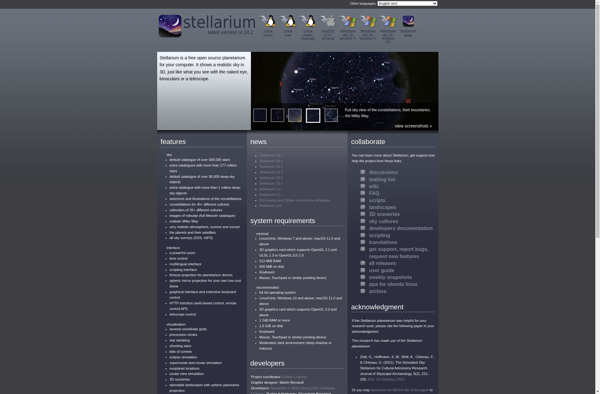
Stellarium is a free, open-source planetarium software that shows a realistic and accurate 3D simulation of the night sky, just like what you can see with the naked eye, binoculars or a small telescope. It is available for Windows, Mac, and Linux operating systems.With Stellarium, you can visualize the actual...
Celestia is a powerful, free, open-source space simulation program that allows users to explore and visualize outer space. It renders high-resolution, photographic images of planets, moons, stars, galaxies, nebulae, and more using real astronomical data. Celestia enables users to travel through space and time, view any object in the universe...
Noctua Stellarium Mobile is a feature-rich mobile planetarium app that allows users to explore the wonders of the night sky from the convenience of their phone or tablet. With over 600,000 stars, a catalogue of over 88 constellations, and realistic rendering of the Milky Way, it brings an immersive stargazing...
Solar System Scope is an interactive 3D simulation of the solar system, planets, dwarf planets, moons, asteroids, comets and spacecraft. It allows users to explore space from any point of view, whether from the surface of planets and moons or out in the depths of space.The software visualizes planetary orbits...
Planetario is a feature-rich, open-source astronomy application for Windows, Mac, and Linux. It provides an interactive 3D simulation of the night sky, accurately displaying the positions and movements of stars, planets, moons, constellations, galaxies, and other celestial objects.Key features of Planetario include:Realistic 3D representation of the night sky from any...
StarCalc is a free and open-source spreadsheet application for Windows, macOS, and Linux. It provides many of the advanced features found in proprietary commercial spreadsheets like Excel, making it an excellent free alternative.Some of the key features of StarCalc include:Support for formulas and functions, including statistical, logical, financial, date/time, lookup,...
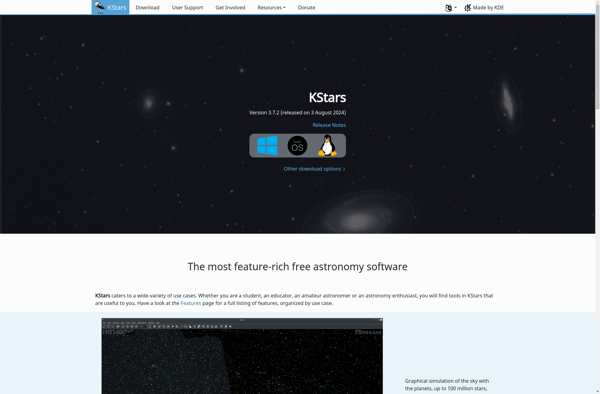
KStars is a powerful open source desktop planetarium software for Linux and other UNIX-like systems. It provides an accurate graphical simulation of the night sky, from any location on Earth, at any date and time. KStars enables users to visualize the positions of stars, planets, comets, supernova remnants and more,...
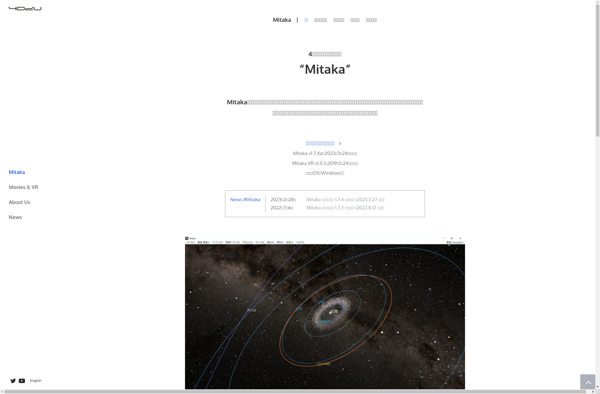
Mitaka is an open-source software application developed for annotating textual data. It is useful for labeling spans of texts such as named entities, emotions, relationships between words/phrases within text sequences.Mitaka provides an intuitive graphical interface for annotating text. It allows users to highlighting words and phrases in a document and...
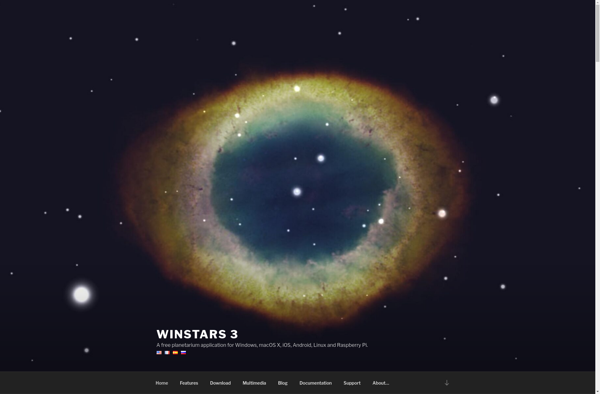
WinStars is a feature-rich desktop customization program for Windows that gives users full control over customizing the look and feel of their desktop. It comes packed with thousands of free themes, icon packs, wallpapers, screensavers, cursors, fonts, and visual styles to completely transform the aesthetic of your Windows desktop.With WinStars,...
Gaia Sky is an interactive 3D software program that models the Milky Way galaxy in striking detail. It uses scientific data from the European Space Agency's Gaia mission and other astronomical surveys to recreate the positions, movements, and details of over 1.5 billion stars in our galaxy. Users can zoom...