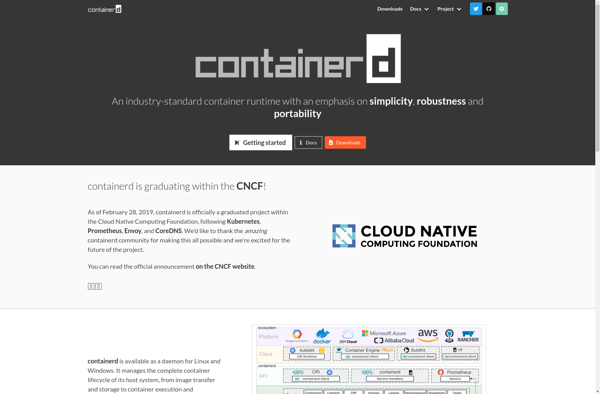
containerd is an open source container runtime that manages the complete container lifecycle of its host system. It is designed to be lightweight and portable to support container execution on a range of operating systems and platforms.
What is Containerd?
containerd is an open source container runtime that is designed to manage the complete container lifecycle for its host system or server. This includes pulling container images, managing storage and network resources, executing containers, monitoring them, and more.
Some key things to know about containerd:
It is lightweight, portable and runs on Linux and Windows servers
Allows clients such as Docker and Kubernetes to access its functionality through GO API/RPC
Focuses on industrial-grade delivery of containers for production environments
Manages images, containers, storage volumes and networking containers
Performs health monitoring and event handling
Integrates with OCI container image format and runtime specifications
Used in cloud architectures that rely on containers and microservices
Overall containerd is optimized to robustly run production containers at scale across diverse infrastructures and platforms. Its modular open source architecture allows it to power higher-level container tools and platforms.
Containerd Features
Features
OCI image format support
Container lifecycle management
Image management
Network primitives for creating CNI networks
Integration with Kubernetes via CRI
Task management via runc/io.containerd.runtime.v1.linux
Pricing
Open Source
Pros
Lightweight and fast
Designed for simplicity
Active open source community
Wide platform and OS support
Cons
Less features than Docker engine
Steeper learning curve than Docker
Requires other components like containerd-shim and runc
Docker is an open platform for developing, shipping, and running applications inside software containers. It provides an additional layer of abstraction and automation of operating-system-level virtualization on Linux, Mac OS and Windows.Docker packages software into standardized units called containers that have everything the software needs to run including libraries, system...
Deis is an open source platform as a service (PaaS) built on top of Kubernetes that allows developers to easily deploy, manage, and scale applications. Some key features of Deis include:Simple Git push deployments - Developers can deploy apps simply by pushing code to a Git repository.Buildpacks - Apps are...
Podman is an open source container management tool meant to be an alternative to Docker. It allows users to run, manage, build, and share Linux containers without relying on a daemon process. Some key features and benefits of Podman include:Podman can run containers without a daemon, unlike Docker which requires...
Apache Mesos is an open source cluster manager that provides efficient resource isolation and sharing across distributed applications or frameworks. It sits between the application layer and the operating system on a distributed system, and makes it easier to deploy and manage applications in large-scale clustered environments.Some key features of...
Distrobox is an open-source container-based application that enables users to run various Linux distributions and software natively on their host Linux system without requiring dual booting or virtual machines. It works by leveraging container technology to isolate distros and software into containers that operate using the host's Linux kernel.With Distrobox,...
LXC (Linux Containers) is an operating-system-level virtualization technology that allows multiple isolated Linux systems to run on a single Linux host. LXC relies on cgroups and namespaces functionality in the Linux kernel to provide strong isolation of resources like CPU, memory, block I/O and network between containers.Some key characteristics of...
Chaperone Process Manager is a small utility application developed specifically for use with Oculus VR headsets. It runs in the background and monitors the processes and services associated with Oculus VR software.The main purpose of Chaperone Process Manager is to provide more control over these background processes to improve system...
OpenVZ is an open source container-based virtualization platform for Linux operating systems. It provides operating system-level virtualization that allows multiple isolated virtual containers, called Virtual Private Servers (VPSs), to run on a single physical server.With OpenVZ, each VPS runs its own operating system and applications separate from the other VPSs...
Turbo.net Client is a desktop application used to access virtual desktops and applications hosted in the cloud or on-premises data centers. It utilizes patent-pending acceleration technology to provide a high-performance user experience compared to traditional remoting protocols.Some key features of Turbo.net Client include:Connection acceleration - Leverages caching, deduplication, compression and...
Stakkr is an open-source personal knowledge management and note taking application developed by Stakkr Labs. It provides users with a flexible system to capture, organize, and retrieve information efficiently.At the core of Stakkr is a card-based interface. Users can create stacks, which are like folders, to organize their content. Within...
DataCol is an open-source data catalog and metadata management software designed to help organizations track, manage and gain insights from their data more efficiently. Here are some key capabilities:Automated data discovery and indexing - DataCol can crawl different data stores like databases, file shares, cloud storage etc. to automatically index...
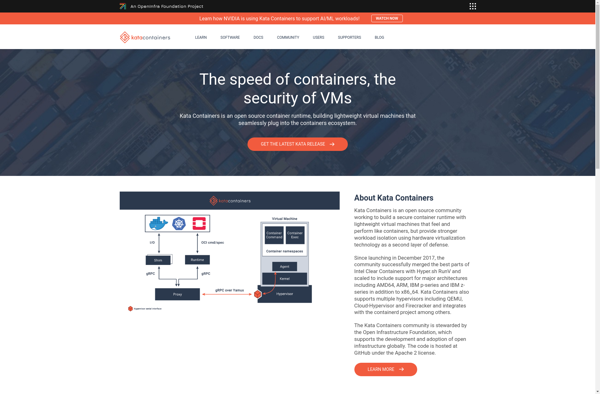
Kata Containers is an open source container runtime that launched in late 2017. It focuses on providing strong workload isolation and security guarantees for containerized applications. Some key aspects of Kata Containers include:Speed - Uses extremely lightweight virtual machines to minimize overhead vs traditional VMsSecurity - Workloads run in hardware...
CRI-O (Container Runtime Interface for OCI) is an open-source container runtime specifically designed for Kubernetes. It implements the Kubernetes Container Runtime Interface (CRI) to enable native Kubernetes support for Open Container Initiative (OCI)-based runtimes and containers.Some key features of CRI-O include:Minimal footprint and dependencies - CRI-O has a very small...
Arkose is an anti-fraud and bot detection service designed to protect websites and mobile apps from automated attacks like account takeover attempts, fake account registrations, scraping attacks, and payment fraud.It works by analyzing user behavior and interactions to identify signs of automation and malicious intent. When risky activity is detected,...